
WARNING: If you (somehow) still haven’t watched or seen anything related to Eurovision 2022, there will be spoilers in this article. Read with caution. Furthermore, this only focuses on the 2022 final. This is just to keep the article short and as objective as possible.
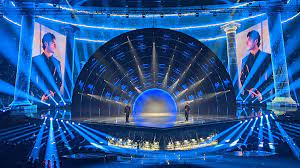
On the 14th of May, the long-awaited grand finale to the Eurovision Song Contest of 2022 aired all across the world. Hosted by Alessandro Cattelan, Laura Pausini and Mika, the event took place in PalaOlimpico of Turin, Italy. The opening act consisted of a rendition of Give Peace a Chance by Rockin’ 1000, along with a series of songs performed by Pausini herself and the Flag Ceremony.
Whether you think Eurovision is the cheesiest pop contest to ever exist, the absolute peak of human history, or just plain camp, it is nonetheless one of the most hypeworthy events in television history. This is especially the case in Australia, one of the only non-European contestants.
Australia’s national representative, Sheldon Riley, was dressed in an assortment of shining gems and lush fur. He sang the song ‘Not the Same’ through a glamorous crystal mask, as vast staircases and strobe lights were shown behind him. It would be an understatement to say that Australia had one of the most dramatic yet touching performances of the show.
The other competing countries, however, stepped up their stage presence as well. Vibrant and strong choreography, wide ranges of artists’ songs, and funky outfits such as wolf-like headgears graced the stage.
But while the show is always known to be extravagant, 2022 was a significant year in terms of Eurovision’s history.
Perhaps this should’ve been a given. Russia, a known participant of Eurovision, and its recent invasion of Ukraine, another known participant, guaranteed that the contest would have to respond to this dilemma. Along with many other entities, Eurovision chose to block Russia from competing this year.
Eurovision’s stance on Russia’s invasion of Ukraine can further be observed throughout the whole competition. Namely, the final’s opening calls out Russia’s acts while also supporting those affected by its wrath.
The same could be said about the competing countries of this year, as the winner of the public vote and a high achiever of the jury vote was none other than Ukraine. Although that is not to say that Kalush Orchestra’s Stefania was a refreshing yet powerful song, being both the first Ukrainian-language and the first rap song to win Eurovision.